

TV Series · 1991
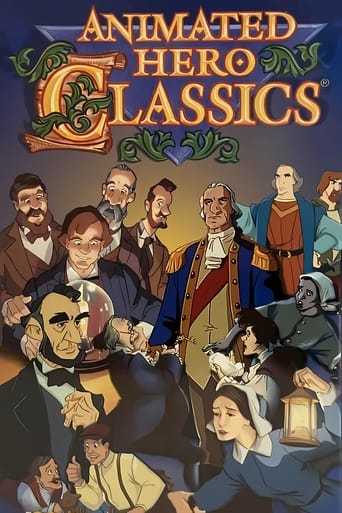
Animated Hero Classics
Action & Adventure, Documentary · Ended
Composite
4.8
IMDb
7.7 / 10
115 votes
TMDB
6.3 / 10
6 votes
Local
— / 10
No votes
Synopsis
Animated Hero Classics is an educational Animated television series of programs co-produced by Nest Family Entertainment and Warner Bros. The series, geared toward elementary school aged children, includes twenty biographies of both female and male scientists, inventors, explorers, and social champions from around Europe, North America and the Middle East, including George Washington, Abraham Lincoln, Florence Nightingale, Harriet Tubman, Joan of Arc, Benjamin Franklin, Helen Keller, Marco Polo, Marie Curie and Louis Pasteur. The Children's Television Act of 1990 required terrestrial television networks to devote time to Educational and Informative programming for children. Even though Warner Bros' cable networks were not directly affected by these requirements, these programs were debuted on their HBO network's Saturday morning children's block as a show of good faith that the network was committed to quality educational programming for children. The dramatic biographies were meticulously researched by the producers and written to engage both children and adults, providing an entertaining and accessible way to learn about the positive impact that these women and men have had on our world.
Streaming availability
flatrate
 Angel Studios
Streaming data provided by JustWatch.
Crew
Directing
- Richard Rich Director
Writing
- Brian Nissen Writer
Seasons & episodes
Season 1 (10 ep)
-
1. Christopher Columbus
Jun 1, 1991
While the whole world sailed east on the path to find China, Columbus believed it could be reached in two weeks… by sailing west! Finally, after securing the support of Queen Isabella of Spain, Columbus set sail. After three weeks of sailing and no sight of land, his crew threatened mutiny. At the moment when all seemed lost and Columbus considered turning back, land was discovered. Columbus realized his dream and America was discovered.
-
2. William Bradford: The First Thanksgiving
William Bradford fled with the Pilgrims to the new world, where he discovered that the price for religious freedom was hunger, sickness and death. As a peacemaker, he befriended the Native Americans who taught the struggling Pilgrims how to survive. By the end of the first year, William Bradford became Governor of the new land. After their first critical harvest, he set aside time for the Pilgrims and their new Native American friends to feast together and express their thanks to God. Thus, William Bradford became the Father of Thanksgiving Day.
-
3. George Washington
George Washington, “The father of America,” comes to life in this remarkable story about his extraordinary accomplishments as a military leader. Retrace Washington’s steps from “the shot heard ’round the world” at Lexington to the dark days of Valley Forge. Follow his contributions to the forming of a new nation and final peace in 1783. This inspiring tale shows Washington at his best—courageous, determined, humble, brave, and patriotic.
-
4. Benjamin Franklin
High into the stormy sky, a kite with iron points bobs in the wind. Suddenly, lightning cuts through the sky and a spark emits from the key attached to the kite string. As Ben Franklin watched the lightning in Philadelphia’s night sky, he came up with a brilliant discovery—one that would change the world forever. Now, through this remarkable story, you can join this remarkable scientist, inventor and statesman as he rewrites human history because of his experiments with electricity.
-
5. Abraham Lincoln
Over a century ago, only one man stood in the way of the disintegration of the United States of America—and he was a gangly, storytelling country lawyer from Illinois with no political experience at the national level. And yet by the sheer force of his will and his uncompromising stand on critical issues, Abraham Lincoln not only saved the nation but carved out an immortal place in world history. This fascinating story inspires viewers with the life of America’s most beloved president.
-
6. Thomas Edison
Never was genius more fun! Thomas Edison opens up the laboratory of America’s most celebrated inventor and invites you to explore its secrets. This fast-paced, bird’s eye view of Edison’s legendary career takes you to behind the scenes to reveal the daily discoveries with “the Wizard of Menlo Park.” Sprinkled with humor and packed with little-known details about the search for a working electric light bulb, this story will help you see for yourself why Edison quipped, “Genius is about one percent inspiration and ninety-nine percent perspiration.”
-
7. Florence Nightingale
It was the height of the Crimean War, and English soldiers were wounded and dying by the hundreds. The shocking conditions of British field hospitals only worsened potential recovery. Into these rat and flea-infested facilities stepped a woman of uncompromising convictions, great patience and an iron will. When Florence Nightingale, “The Lady of the Lamp,” arrived on the scene, the science and practice of nursing soon changed all over the world, forever.
-
8. Pocahontas
Except for the raw courage of Native American princess, Pocahontas, the English settlers at Jamestown in the early 17th century would have died from starvation and exposure. Her brave intervention saved the settlers’ lives and brought peace between two very different peoples. Recapture all the drama and suspense that filled the early days of America’s colonization. History comes alive as you meet an inquisitive girl who grows into a great ambassador for peace.
-
9. Louis Pasteur
Apr 4, 1995
The time is 1860, and cholera is beginning to spread throughout France's chicken population. Louis Pasteur and his assistant, Emile Roux, collect samples and deduce that disease can be transmitted through air. They then draw blood from the chickens and see an unidentified germ in the specimens. While Pasteur and Roux work with the samples of blood, Pasteur has a debilitating stroke. From his bed, he expresses his determination to live, and continues to work with Roux by writing him notes. He tells Roux to inject the chickens with the contaminated blood. The chickens die. When Pasteur finally comes back to the laboratory, they discover the blood has altered from time. When they inject this blood into the chickens again, the cholera germs are killed.They have created a vaccination for the chickens. Meanwhile, sheep begin to die from anthrax. Even though other scientists mock Pasteur's findings, they agree to let him experiment on 25 sheep...
-
10. Maccabees: The Story of Hanukkah
Journey to Palestine of the second century B.C., where Antiochus, a Syrian-Greek king, rules over the people of Israel, confronting them with a trying test of their faith. They must bow down and accept the Greek gods…or die! Some submit, but not the Maccabees, a small group true to the faith of their fathers. The spirit and determination of the Maccabees lives today in the celebration of Hanukkah, The Feast of Lights.
Season 2 (1 ep)
-
2. Beethoven
Jan 1, 2005
Even as a young boy, Beethoven marched to the beat of a different drummer. Trained in the traditional music methods by his father, Beethoven was an accomplished pianist by the age of 12. But he yearned to try new sounds and persevered until audiences heard his music. By his early twenties, this persistent young man performed for Joseph Haydn, who compared him to the great Mozart. Sadly, Beethoven began to lose his hearing, but he threw himself even more deeply into his music, composing "Fur Elise," "Sonata Pathetique" and the dramatic "Fifth Symphony" years later, audience members heard what he could not and leapt to their feet in ecstatic appreciation for such passionate music. His creativity gave the world then, as it does today, music that stirs the soul. The video begins in 1827 with 30,000 people paying tribute to the great Beethoven in Vienna, Austria. Then the video switches to his life as a child. Beethoven was driven by his father without patience and love to practice playing the music of Mozart and Haydn on the piano; however, Beethoven preferred to improvise and play his own style of music. This enraged his father as it did many symphony patrons later in life. Beethoven was honored to be asked to move to Vienna and have Haydn as his instructor. After years of playing for royalty, Beethoven was frustrated that all the audiences wished only to hear music from Mozart and Haydn. So, Beethoven decided to move to the countryside where he could compose music as he wished. While living in the countryside, Beethoven noticed his hearing loss was getting more severe and feared going deaf. The world was going through a revolution. The America Colonies threw off the British Empire, and common people replaced the King and Queen of France. Beethoven believed that since the world was changing all around him that music should change also. Beethoven's performances were not embraced by the majority because of his visceral style and the war going on around him; however, Beethoven never gave up despite his despair and lack of encouragement. His courage to keep writing from the heart and his desire to play from the heart would eventually be accepted by the world. As a tribute to the soldiers, Beethoven was commissioned to write a symphony in honor of Wellington's victory over Napoleon. "The Wellington's Victory" was a favorite of the people of Vienna even though it was not one of Beethoven's favorites. Tragically, Beethoven's success could not be enjoyed. His health was fading quickly. In his last days, Beethoven finally wrote the symphony that touched his heart. The Ninth Symphony was his final work with the choral music put to Schiller's poem, "Ode to Joy." "Ode to Joy" spoke to the heart with words, and Beethoven's Ninth Symphony spoke to the heart with music. Sadly, Beethoven did not conduct his last piece of work because of his complete hearing loss. The applause was not heard by Beethoven; but the sight of the audience standing and continually applauding was Beethoven's acknowledgment of the appreciation felt by the Vienna people and the world.
Similar titles
The Lord of the Rings: The Rings of Power
2022 · 8.7

NCIS
2003 · 9.8
Game of Thrones
2011 · 10.0
Reacher
2022 · 9.9

Smallville
2001 · 9.8

Doctor Who
2005 · 9.9

Hawaii Five-0
2010 · 9.6

S.W.A.T.
2017 · 9.4

Ninjago: Masters of Spinjitzu
2012 · 9.5

24
2001 · 9.9
Stranger Things
2016 · 10.0

JAG
1995 · 5.4